Scoot
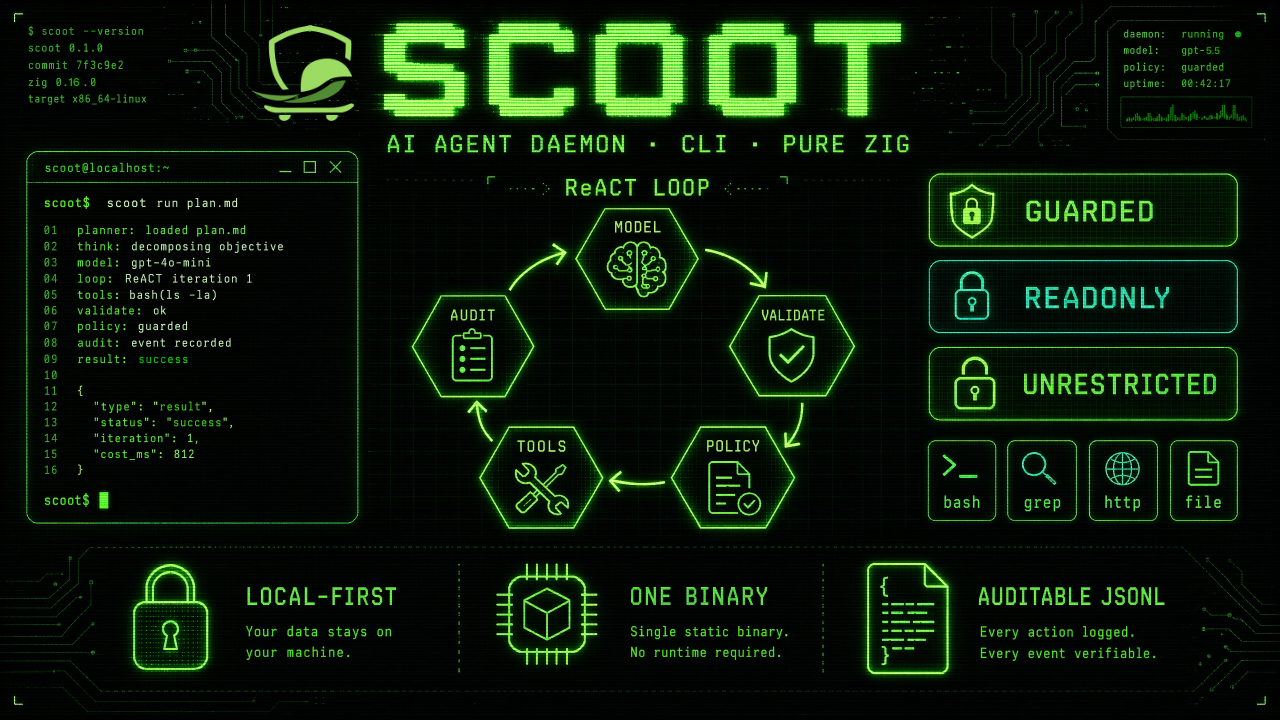
Scoot is a lightweight, local-first AI agent daemon and CLI written in pure Zig. It drives an OpenAI-compatible model backend through a defensive ReACT loop, validates every structured step the model produces, runs local tools behind execution-policy gates, and records each step as auditable local state.
It is built for plain-text environments — servers, containers, CI runners, embedded Linux — where you want an automatable agent that is small, predictable, and fully inspectable, with no GUI, no cloud sync, and no plaintext secrets.
How It Works
Every turn runs the same defensive loop:
- Ask the model for exactly one structured step (
thought+action+action_input). - Validate the step against a strict JSON schema (never execute free-form text).
- Gate the action through the active execution policy (
guarded/readonly/unrestricted). - Run the selected built-in tool inside a sandbox with a hard timeout.
- Audit the action and write it to the session transcript and audit log.
- Observe — feed the tool’s output back to the model as the next observation.
The loop repeats until the model emits a final answer or hits max_turns.
Core Capabilities
- Two entry points — one-shot
scoot -e "<goal>"and an interactive REPL. - Twelve built-in actions —
bash,file_read,file_write,file_edit,grep,glob,outline,http_request,skill,recall,parallel, andfinal. The structured tools work without external commands, so they behave identically on stripped-down systems. See Built-in Tools. - Three execution policies —
guarded(interactive tripwire with default write-confinement and SSRF guard),readonly(fail-closed), andunrestricted(audited but unlimited). See Execution Policy & Security. - Local skills with progressive disclosure — task-specific instruction packs
discovered from the project and user directories, read through a native,
read-only
skillaction. See Skills. - Scheduling & daemon mode — unattended jobs that always run with
fail-closed
readonlysafety unless you opt into more. See Scheduling & Daemon. - Auditable state — sessions and audit events persisted as append-only JSONL. See Sessions & Audit.
- Flexible config & secrets — TOML first, JSON fallback, secrets loaded from
an env var, a
0600token file, or a credential command — never inline. See Configuration.
Quick Start
# 1. Build (Zig 0.16+).
zig build
zig build test

# 2. Point Scoot at a backend (defaults to a local Ollama-compatible endpoint).
export OPENAI_API_KEY="sk-..."          # only if your backend needs a key

# 3. Inspect the resolved runtime and health.
./zig-out/bin/scoot config
./zig-out/bin/scoot doctor

# 4. Run a one-shot goal, or start the REPL.
./zig-out/bin/scoot -e "count the Zig source files in this repository"
./zig-out/bin/scoot            # interactive REPL; /exit to leave
New to Scoot? Read Installation → Configuration → CLI Reference. Want to understand what the agent can do? See Built-in Tools and Execution Policy & Security.
Runtime Directory
Scoot keeps everything under ~/.scoot by default. Override it with the
--scoot-home flag or the SCOOT_HOME environment variable (the flag wins).
~/.scoot/
  config.toml      # configuration (config.json is the fallback)
  token            # optional 0600 API token file
  skills/          # user-level skills
  logs/            # audit / run logs (audit.jsonl)
  state/           # sessions, daemon lifecycle, scheduler state
Start from config.example.toml — copy it to
~/.scoot/config.toml and edit.
Design Principles
Scoot is intentionally conservative. These are non-negotiable boundaries, not preferences:
- local-first runtime state, one small binary, no GUI;
- OpenAI-compatible backends only — no provider-specific protocol sprawl;
- no plaintext secrets in committed config, logs, or audit output;
- no execution of unvalidated model output;
- skills add instructions and data, never a privileged execution path.
See the Roadmap and Agent Guide for the full set of rules that govern how Scoot evolves.